
Food as medicine: Expanding a Kentucky collaboration to improve health outcomes
Access to nutritious food significantly impacts health outcomes. In Kentucky, 16.6% of residents experienced food insecurity in 2023, meaning many households face limited access to nutritious food.1 When individuals lack reliable access to healthy foods, the consequences can directly affect their ability to manage chronic conditions and maintain healthy pregnancies. According to the 2025 KY Diabetes Report, 13.7% of adults, nearly 482,202 Kentuckians, had diabetes in 2023.2 At the same time, maternal health outcomes continue to draw attention across the Commonwealth.
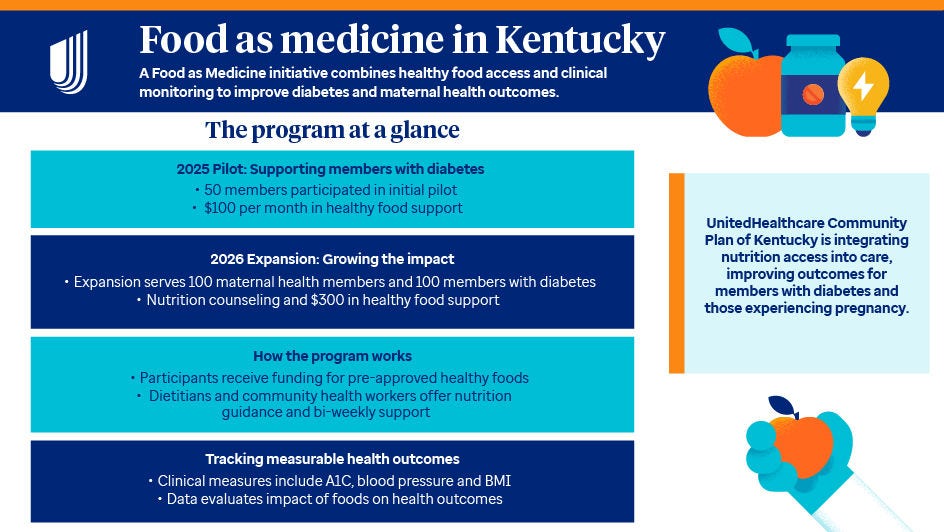
Recognizing the connection between nutrition and health, UnitedHealthcare Community Plan of Kentucky collaborated with the University of Kentucky’s Food as Health Alliance to launch a Food as Medicine pilot program which served 50 members in 2025. Building on the success of that pilot, UnitedHealthcare is expanding the program in 2026 with a $105,000 investment, growing the initiative to serve 200 members, including 100 maternal health members and 100 members with diabetes.
Building on a successful 2025 pilot
The original 2025 pilot focused on members diagnosed with diabetes, providing $300 in healthy food support over a three-month period. Participants used these funds to purchase approved nutritious foods designed to support better diabetes management. Alongside the grocery support, the program included clinical monitoring to evaluate the impact of improved nutrition access. Baseline and follow-up measures such as Hemoglobin A1C and other relevant health indicators allowed the program team to assess changes during the intervention period.
The pilot also helped establish the operational framework for the program. UnitedHealthcare Community Plan of Kentucky and the University of Kentucky’s Food as Health Alliance collaborated to build screening, enrollment and engagement processes that supported coordinated outreach and participation. Lessons learned from this initial cohort informed how the program could scale in future years, helping guide the design of the expanded 2026 initiative.
Expanding to reach 200 members in 2026
In 2026, UnitedHealthcare is expanding the program to serve 200 members through two targeted pilots, one focused on maternal health and one focused on diabetes management. The health plan’s quality team will identify eligible members using clinical criteria and refer them to the University of Kentucky for outreach and enrollment. Members who choose to participate will receive a $300 grocery benefit that can be used to purchase pre-approved healthy foods.
Participants will have flexibility in how they access their grocery benefit. Members may choose online ordering or in-store purchases, allowing them to select foods that fit their household needs while ensuring purchases align with the program’s nutrition guidelines. The program also includes nutrition counseling, case management and reporting services that help track outcomes and engagement.
Integrating nutrition with clinical support
While expanding access to healthy food is central to the initiative, the program is designed to provide layered support throughout the intervention period. Registered dietitians review monthly food purchases and offer personalized recommendations to help members make the most of their grocery benefit. Community health workers conduct bi-weekly check-ins, helping participants stay engaged while addressing barriers that may arise during the program. Participants also receive telehealth sessions with registered dietitians totaling approximately 90 minutes of structured nutrition counseling, providing guidance on meal planning, food selection and long-term dietary habits.
To evaluate the program’s impact, participants agree to follow-up physician visits and lab draws. This allows the care team to compare baseline and post-intervention clinical measures such as A1C levels, blood pressure and body mass index (BMI). By linking food access directly to clinical monitoring and care coordination, the program helps translate healthier eating into measurable health outcomes.
Advancing innovation in food as medicine
The collaboration between UnitedHealthcare Community Plan of Kentucky and the University of Kentucky demonstrates how managed care organizations and academic health systems can work together to address food insecurity as part of clinical care. By establishing secure referral pathways, participant consent processes and outcome reporting, the program builds the infrastructure needed for potential future scalable models, including Medicaid-aligned nutrition benefits and In Lieu of Services (ILOS) pathways.
Treating food as a component of care
The expansion of the Food as Medicine initiative highlights the recognition that food security directly influences health outcomes, particularly for diet-sensitive conditions such as diabetes and maternal health. Through a $105,000 investment to serve 200 members in 2026, UnitedHealthcare Community Plan of Kentucky is scaling a structured, data-driven model that combines nutrition access with clinical accountability. This work demonstrates how managed care organizations can advance innovative solutions to address social drivers that impact health.
Enjoy this article? Get future Community & State insights delivered right to your inbox.
For more information about the work that we are doing in the Commonwealth, visit our Kentucky profile page.